

DRAGON
FICCIONES

Johann Sebastian Bach
(1685 - 1750)
A magnificent baroque-era composer, Johann Sebastian Bach is revered through the ages for his work's musical complexities and stylistic innovations.
The Life of JS Bach
Johann Sebastian Bach, the last of eight children, was born in Eisenach March 21 1685 into a multi generational family of musicians who resided in the Thuringia section of south central Germany. The Bach dynasty spanned five generations generating high quality musicians, culminating with JS Bach.
It starts with Veit Bach, a musically inclined bread baker in the early 1500’s, and stretching to the 1800’s, ends with the death of Wilhelm Friedrich Ernst Bach on December 25, 1845. The grandson of Bach was last in the lineage with serious musical inclinations. Bach’s father, a gifted violinist, was town music director in Eisenach. Some responsibilities included providing music on the town hall balcony at 10am and 5pm overlooking the market and weekend church services.

Eisenach, birthplace of Bach
Johann lived in Eisenach from 1685 until 1695, starting school at age five, as was typical then. Suddenly at age nine first his mother dies, then soon after his father, after having remarried. Now an orphan young Sebastian and his brother Jacob utilize the extensive regional family connections and move in with their older brother Johann Christoph. Recently appointed as organist in Ohrdruf, he was to become a major influence in Bach’s formative years. He is listed in Bach’s personally compiled family record called the “Obituary” as his only teacher. This idea accords to his son C.P.E. Bach that Johann was mostly a self taught genius.

For ten years until 1700 Bach now age 15 attended school and pursued the study of music while being completely surrounded by it. He then decided to attend and was anticipated at the prestigious St Michael’s School in Lüneburg 200 miles to the north where he continued in his academic and musical studies. Bach was leaving his home area with an extremely well rounded music education and little cash, to be near Hamburg, then the largest city in Germany with it’s fine organs and music. Important were his connections and meetings with organists Georg Böhm and Johann Adam Reinken.
After graduating in 1702 and in need of finding a way to support himself, he traveled back to Thuringia and found work, in particular at the Weimar Court, which he will return to in later years. Bach secured an organist position in Arnstadt in 1703 that lasted until 1707. He had few responsibilities and comfortable living quarters, allowing for an enormous amount of self study. So between the ages 18-22 Bach had ideal conditions to practice on a brand new church organ, compose, direct choirs and hone his craft. In December 1705 Bach set out 250 kilometers on foot to visit organist Dietrich Buxtehude in Lübeck, returning several months later than agreed upon with his employer.

in Bach’s hand, music for Violin Solo
From 1707-1708 Bach worked for the city of Mülhausen as town organist. Around this time Bach is married with his first wife, Maria Barbara. His next appointment was at Weimar again, though this time as Court Organist in 1708. This lasted until 1714 where his responsibilities changed and he received the title of Concertmaster until 1717 when he left. It was at Weimar that Bach saw the genius in the Italians Vivaldi, Corelli, Albinoni and others and utilized their compositions as tools for further musical explorations.
It could be said that Bach’s time in Cöthen between 1717-1723 had some of the most ideal work conditions he experienced. Employed by the musically talented and very supportive Prince Leopold, Bach now had the esteemed title of Kapellmeister. The Prince over time employed some of the top musicians in Germany to have a world class ensemble at Bach’s disposal. There was also tragedy. Upon Bach returning from a weeks long outing with the Prince he comes home to find his wife dead and buried. Soon after Bach remarries to a younger professional singer Anna Magdelena. In all Bach would sire 20 children with two wives, only ten of which would survive youth. The ideal conditions at Cöthen took a turn for the worst as the Prince marries someone disinterested in music, who then influences the Prince, and over the course of Bach’s last year there scaled the budget way back, had the music program reduced, and created a stifled atmosphere.
The next move would be Bach’s final, the one to Leipzig in 1723 for a position of Kantor at the St Thomas School. Bach and his growing family moved into the downtown university building, with three stories. His apartment opened into the school, so Bach had close physical ties with the University as well as the four main churches in the city for which he was musically responsible. In the 1720’s one of Bach’s main projects was working with cantatas and he set the standard to this day regarding four part harmony. Disagreements between Bach and the city were at times ongoing, where letters were written, some surviving, showing how Bach had to defend his stance and integrity. A project Bach took on in the 1730’s had him oversee some 500 weekly ‘Collegium Musicum’ concerts at Cafe Zimmerman in downtown Leipzig, comprised of his students, professionals and others.
Bach was extremely busy and industrious throughout his life. The 1740’s saw Bach refining his own work, always redefining the parameters of musical artistry. Music historians are unable to figure how Bach accomplished all the work he did. Composing, conducting, the many students, family life, visiting musicians, performances… that Bach lived a relatively stable family life and didn’t travel much helped him accomplish all he did. He also had a deep connection with the land in which he lived and a strong bond with his ancestors and family in general. The Bach clan would have yearly gatherings until near the end of Bach’s life, by which time the demise of the bloodline started to take place.
There is relatively little information on Bach’s personal life. The music, a handful of letters, some legal documents, eyewitness accounts passed on, family anecdotes, bookkeeping records, several portraits, and travels with associates is what we have to create a picture of this towering musical genius. Johann Sebastian Bach died on July 28 1750 after declining health and a botched eye operation leaving a musical legacy for the ages.
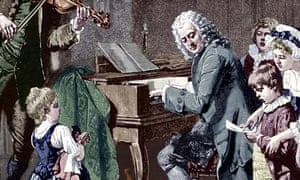
Revealed: the violent, thuggish world of the young JS Bach
John Eliot Gardiner's research has shattered 'sanitised' versions of the composer's life
Dalya Alberge
Saturday 21 September 2013
Johann Sebastian Bach is arguably the greatest of all composers, with the St Matthew Passion and the Mass in B Minor among the most sublime masterpieces in classical music. But biographers over the past half century have "sanitised" his life, in the belief that only a saintly man could have written such heavenly music, according to one of the world's leading conductors and foremost interpreters of Bach.
After years of research, Sir John Eliot Gardiner says biographers have been so "overawed" by the composer that they have presented a misleading image of the man. They have depicted him as a "paragon of rectitude, studious and dull, with the false assumption that music of such extraordinary and sublime quality must have come from somebody who was beyond criticism".

Gardiner added: "The reality seems very different … You'd expect a more accurate and less rosy-tinted version of him."Archival sources, including school inspector reports, reveal that Bach's education was troubled by gang warfare and bullying, sadism and sodomy – as well as his own extensive truancy.
His first school, Eisenach Latin school in Thuringia, Germany, was largely attended by the children of bourgeois tradespeople. However, Gardiner said that documents damn the boys as "rowdy, subversive, thuggish, beer- and wine-loving, girl-chasing … breaking windows and brandishing their daggers". He added: "More disquieting were rumours of a 'brutalisation of the boys' and evidence that many parents kept their children at home – not because they were sick, but for fear of what went on in or outside school." For punishment, Bach's contemporaries endured beatings and the threat of "eternal damnation". Such experiences must have left "lasting scars" on him, Gardiner believes.
Gardiner examined records in three schools Bach attended – Eisenach Latin, Ohrdruf Klosterschule and Michaelisschule, Lüneburg. "From the tone of the school reports, it sounds as if the authorities were really worried that the situation had got out of hand. There was something exceptional, certainly in Eisenach." A "villain of the piece", Gardiner discovered, was a form master and church cantor at Ohrdruf, where Bach was a chorister. The teacher was a sadistic disciplinarian meting out "intolerable punishments". He was eventually sacked as "the plague of the school, the scandal of the church and the cancer of the city", but the 12-year-old Bach had endured "unusually close exposure to him", Gardiner said.
Among Lüneburg's town records, he found reports on antisocial behaviour of two schoolboys in a local hostelry – "thoroughly drunk and … slashing … with [their] dirks and hunting knives". One is believed to have been Bach's mentor. Gardiner writes of sufficient evidence "to dent the traditional image of Bach as an exemplary youth … surviving unscathed the sinister goings-on in the schools he attended. It is just as credible that [he]… was in a line of delinquent school prefects – a reformed teenage thug." He added that Bach's repeated absences – 258 days in his first three years – are traditionally attributed to his mother's illness and his work in the family music business. But there could be a more sinister interpretation, he said, that the school conditions may have been so unappealing and even threatening.
Gardiner was "taken aback" to find that such archival evidence had initially been researched in the 1930s but "completely ignored and sanitised in biographies of Bach". He added: "It puzzled me why the standard biographies have just ignored that."
His research will be published by Penguin on 3 October in Music in the Castle of Heaven: A Portrait of Johann Sebastian Bach. Gardiner argues that Bach's compositions became a receptacle for the turbulence in his life, including the loss of his parents as a child and later his first wife and 12 of his 20 children before they had reached the age of three – "well beyond the average, even at a time when infant mortality was ubiquitous".
Although the impact on Bach of the violence and family losses is speculative, any insight into his early years is all the more significant as less is known about his private life than that of any other major composer of the last 400 years, says Gardiner. "We yearn to know what kind of a person was capable of composing music so complex that it leaves us completely mystified, then … so irresistibly rhythmic that we want to get up and dance to it, and then … so full of poignant emotion that we are moved to the very core of our being."

Bach
Students
Numerous testimonials Bach wrote for his best students demonstrate the comprehensive experience they gained under his tutelage. As a case in point, we read in a 1730 letter of reference for Johann Christian Weyrauch, candidate of laws, “that he not only masters various instruments but can also well afford to make himself heard vocaliter, he has given many examples of his skill, and also can show on request what he has done in the art of composition.” A testimonial from 1748 for Johann Christoph Altnickol, candidate of theology but provided by Bach with the self styled academic title of “candidate in music,” relates that it’s bearer “not only did . . . act for four years diligently as assistant for our Chorus Musicus, but he has also shown, in addition to his vocal performance, such outstanding work on various instruments as one could desire from an accomplished musician. A number of fine compositions of his have found no less ample approval in our town.
The wealth of performance activities introduced Bach’s students to many of the basics any musical leader had to master, from the right way to position ensembles in different performing spaces to the design of instruments, their technology, and their proper use. Here they benefited from Bach’s own hands-on experience, as son Carl Philipp Emanuel recalled in 1775: “As a result of large-scale performances of music in churches, at court, and often in the open air, in strange and inconvenient places, he learned the placing of the orchestra, without any systematic study of acoustics. He knew how to make good use of this experience, together with his native understanding of building design so far as it concerns sound; and these were supplanted in turn by his special insight into the proper design of an organ, the disposition of stops, and placing of the same.”
Bach always stressed the practical side of music, if only to confront his students with the results of their efforts, so he kept them away from purely speculative matters. Again, Carl Philipp Emanuel underscored that his father “like myself or any true musician, was no lover of dry, mathematical stuff.” Even when he taught musical composition, Bach disregarded neutral writing exercises and trained his students directly on the basis of keyboard practice, introduced them to the principles of thoroughbass as the foundation of music, and had them conceptualize chorale harmonization as the interplay of polyphonic voices: “Since he himself had composed the most instructive pieces for the clavier, he brought up his pupils on them. In composition he started his pupils right in with what was practical, and omitted all the dry species of counterpoint that are given in Fux and others. His pupils had to begin their studies by learning pure four-part thoroughbass. From this he went to chorales; first he added basses to them himself, and they had to invent the alto and tenor. Then he taught them to devise the basses themselves.”
The methodical approach of Bach’s teaching was special in every respect but truly unique in the sophisticated and challenging materials he provided. His approach is brought to life in an illuminating account in 1790 by Ernst Ludwig Gerber, author of the first comprehensive biographical dictionary in music. There he reports on the education that his own father, Heinrich Nicolaus Gerber, received when, at age twenty-two, he
“went to Leipzig, partly to study law and partly to study music with the great Sebast. Bach . . . In the first year, as he arranged his courses, he had heard much excellent music and many a concert under Bach’s direction; but he had still lacked any opportunity that would given him enough courage to reveal his desires to this great man; until at last he revealed his wish to a friend, named [Friedrich Gottlieb] Wild, later organist at St. Petersburg, who introduced him to Bach. Bach had accepted him with particular kindness because he came from the [Thuringian county of] Schwarzburg, and always thereafter called him Landsmann [compatriot]. He promised to give the instruction he desired and asked at once whether hew had industriously played fugues. At the first lesson he set his Inventions before him. When he had studied these to Bach”s satisfaction, there followed a series of suites, then the Well-Tempered Clavier. The latter work Bach played for him altogether three times through for him with his unmatchable art, and my father counted these among his happiest hours, when Bach, under the pretext of not feeling in the mood to teach, sat himself at one of his fine instruments and thus turned these hours into minutes. The conclusion of the instruction was thoroughbass, for which Bach chose the Albinoni violin solos; and I must admit I have never heard anything better than the style in which my father executed these basses according to Bach’s fashion, particularly in the singing of the voices. This accompaniment was in itself so beautiful that no principal voice could have added to the pleasure it gave me.”
While in Bach’s tutelage, Heinrich Nicolaus Gerber copied the materials he was given to study, signing the finished volumes adding his name to them. The manuscripts Gerber assembled from late 1724 to 1726 corroborate the information in the biographical report, even in terms of their chronological sequence: at he beginning, we find the Aufrichtige Anleitung (Gerber copied all fifteen inventions and fifteen sinfonias), then eight French and seven English Suites (copied from a larger collection of suites with and without preludes) and twenty-one movements from the partitas that were published in 1731 as Clavier-Ubung and realizations of the Albinoni figured bass (including Bach’s corrections) – a truly demanding course of study for only two years.
Heinrich Nicolaus Gerber, later court organist at Schwarzburg-Sondershausen, was one of a large and impressive group of composers who received their training from Bach and that included, apart from Bach’s own sons, Carl Friedrich Abel, royal court musician in London; nephew Johann Ernst Bach, court capellmeister in Eisenach; Johann Friedrich Doles, Bach’s second successor in Leipzig; Gottfried August Homilius, cantor in Dresden; Johann Ludwig Krebs, court organist in Altenburg; Johann Christian Kittel, town organist in Erfurt; Johann Gottfried Müthel, city organist in Riga; and Johann Trier, organist in Zittau. A substantial number of Bach’s students also engaged in literary contributions and theoretical writings on music; aside from sons Wilhelm Friedemann and Carl Philipp Emanuel, the most prominent were Christoph Nichelmann, Lorenz Christoph Mizler, Johann Friedrich Agricola and Johann Philipp Kirnberger.
For Bach, a steadfast working relationship with his best students must have been particularly important, and at times even crucial, not only for what they learned from him but also what he picked up from them: from their academic studies and from their musical interests and contributions, as his own changing stylistic orientation in the 1730’s and 1740’s definitely reflects. He may also have hoped that they would carry on his ideas – perhaps remembering the encouraging words said to him by the venerable old organist Reinkin: “I thought that this art was dead, but I see that in you it still lives.” But if such wishful thinking ever crossed Bach’s mind, it did not come true, as none of his students came remotely close to Bach’s mastery in either composition or performance or in his intellectual control over and penetration of musical subject matter. They did, however, play all the more important role in the preservation, dissemination and veneration of their teacher’s incomparable music. In particular, their faithful spreading of his musical methods and principles shows that Bach’s inordinate in the teaching of his musical philosophy was by no means in vain. On the contrary, scores of students and their pupils’ students helped organize and eventually consolidate Bach’s lasting influence, a phenomenon that none of Bach’s contemporaries sustained. Neither Handel nor Scarlatti, Rameau, nor Telemann ever engaged so fully in the kind of teaching Bach enjoyed throughout his life. More important, none of them could, as Bach did, put their teaching on an academic stage – the secret that allowed his smallish world to burst into a limitless orb.
Christoph Wolff: Johann Sebastian Bach, The Learned Musician – pages 327-331

Bach
Cöthen
For Prince Leopold, hiring Bach was a real coup, and for Bach, the newly expanded Cöthen court capelle provided a much more attractive and promising situation than Weimar. In 1703, the eighteen-year-old Bach was looking forward to a career as an organist; in 1717, he had effectively brought that career to an end, at least in a formal sense, for he would never again hold a post as organist. The chapter as court organist at Weimar was closed, and he had now, at age thirty-two, reached the peak of the conventional musical hierarchy. He was headed for Cöthen to take his place as princely capellmeister.
Eager to get away from Weimar, he was looking forward to a new opportunity: he could expect to work for a patron whose musical background and interests were as strong as he could wish for and whose personal support was unquestionable; he would be one of the best-compensated court officials in the principality, evidence of the prestige that came with the position and the high priority assigned to it by the reigning prince; and he would be in charge of an elite professional ensemble whose core group of musicians had recently been recruited from Berlin and whose overall caliber by far exceeded that of the Weimar ensemble.
Bach picked up his first pay on December 29, 1717; the wording in the princely account records – “the newly arrived Capellmeister” – suggests that he arrived just in time for celebration of New Year’s Day, traditionally one if the major musical events of the Cöthen court. Contrary to a long-held view, he did not move to Cöthen right after his release from detention and dishonorable discharge from the Weimar court on December 2, or there would have been an earlier payment record.
In 1713, a unique opportunity arose for the Cöthen court to hire at one stroke a substantial contingent of excellent musicians. This came about when Friedrich Wilhelm I of Prussia, the “Soldier King” rose to power in-not-too-distant Berlin and dissolved his father’s cherished court capelle. The young Prince Leopold, not yet of age and still on his grand tour, learned about the Prussian king’s act of cultural barbarism, through indirect channels or perhaps through relationships formed at the Ritteracademie in Berlin. In any case, he managed to persuade his mother to hire a core group of virtuosos for the Cöthen capelle. Indeed, she proceeded so swiftly that around the beginning of 1713, six distinguished musicians moved from Berlin to the small residential town of the Anhalt-Cöthen principality, some hundred miles away.

Relocating his family and personal effects to Cöthen, some seventy miles northeast of Weimar, was a much bigger undertaking than his move nine and a half years earlier from Mühlhausen to Weimar. The family had grown to six, with the oldest daughter Catharina Dorothea, now nine years old and the three boys, Wilhelm Friedemann, Carl Philipp Emanuel, and Johann Gottfried Bernhard, seven, three and two, respectively; Maria Barbara’s sister Friedelena came along, too. For the first three and a half years, the Bach family rented a spacious apartment in a house close to the main gate of the princely palace (most likely at what is today’s parsonage, Stiftstrasse). When that house was purchased in 1721, Bach probably moved to another (unknown) place, likely again no more than a short walk away from the palace.
The dearth of information on details of musical life at the princely court combined with the losses of repertoire, in particular of Bach’s own compositions for the Cöthen capelle, does not obscure the fact that Bach found himself in a musically ideal situation. First, he was working with a capelle whose professional core group comprised some of the finest musicians. Second, the demands of the office left him considerable time to pursue his own interests. But most important of all, he found himself under the patronage of a supportive and understanding prince whose notions of courtly splendor sought to balance modest understatement with luxurious excess. In a 1730 letter to his Luneburg classmate Georg Erdman, Bach seems to wax nostalgic about his time as Cöthen capellmeister: “There I had a gracious Prince, who both loved and knew music, and in his service I intended to spend the rest of my life.” Even if the last phrase is not to be taken literally – for one can hardly imagine Bach not feeling the overall limitations and constraints of the remote Cöthen scene – it emphasizes his overall satisfaction.

On the other hand, the letter goes on to point at a turn of events that soon contributed to Bach’s seeking a new venue. “It must happen,” he wrote, that the said “Serenissimus should marry (December 11, 1721) a Princess of Bernburg, and the impression should arise that the musical interests of said Prince had become somewhat lukewarm, especially as the new Princess seemed to be an amusa.” Sometime after the wedding date, Bach noticed a change in the court’s attitude towards musical affairs, which he attributed to a negative influence of the unmusical princess of his patron. It is hard to measure objectively if this attempt at accounting for something that Bach could not otherwise explain has any legitimacy. Besides, the princess died before Bach left Cöthen. (Her death on April 4, 1723, would also had called for a work by the court capellmeister, but no such funeral piece has shown up.) Clearly measurable, on the other hand, is a drop in the court’s budget for musical activities. After a noticeable increase in expenditures for the first two fiscal years (July to June) after Bach’s appointment, appropriations decreased for 1720-21, remained flat for another year, and decreased again for 1722-23, Bach’s last year in office. The development is anything but dramatic, as the average music allotment amounted to only 4 percent of the entire court budget.
The loss of original sources, especially of performing materials, and the absence of information about Bach’s regular musical activities at the Cöthen court apart from birthday and New Year’s festivities extend to the instrumental repertoire as well. However, there exists virtually no tangible evidence that any of the known concertos, orchestral suites, or sonatas by Bach were actually performed, let alone composed in Cöthen, with the sole exception of an original set of parts dating from about 1720 for the Brandenburg Concerto No. 5, BWV 1050. At the same time, it is inconceivable that capellmeister Bach did not compose most of the standard repertoire that the Cöthen capelle needed for its regular performances, the rest consisting of a broad selection of works by other composers.
The capelle kept one salaried copyist and even paid an additional copyist repeatedly from 1719 to 1721, indicating that the preparation of new performing materials required more than one. Moreover, expenses for the music library regularly included bookbinding costs. Curiously, no expenses for the purchase of manuscript or printed music are recorded before 1723, which likely means that most or all of the music was produced by Bach and other composer-performers of the capelle. But the book binding costs were considerable; in 1719-20, for example, they amounted to 30 talers, a sum sufficient to bind scores and parts for some fifty ensemble and orchestra works of medium size, or roughly one new work per week. Though this amount only represents a ballpark figure, it looks entirely reasonable – not just for a single year but for the entire period of Bach’s capellmeistership – and would anticipate the cantata production schedule Bach later followed in Leipzig. In over five years, from the beginning of 1718 to May 1723, that would have amounted to well over 350 compositions, mainly chamber and orchestral music, but also serenades and other vocal works. And even if only two-thirds of this repertoire stemmed from the capellmeister’s pen, the assumed losses would exceed 200 pieces.

At the beginning of his capellmeistership, Bach was able to add members to the capelle and, by 1718-19, to achieve a net gain, yet now he had to preside over net losses. The period of modest growth for the Cöthen capelle was indeed short, and even though the budget for the court music showed no real downturn until 1721-22, Bach must have seen the writing on the wall, or else he would not have considered, in late 1720, the organist post at Hamburg’s St. Jacobi as a possible alternative. A period of genuine financial and personnel retrenchment at the court began in 1721, coinciding, in Bach’s perception, with the end of his patron’s bachelorhood.
In a report of 1722, a cantor in Cöthen extolled Bach’s regular rehearsal practice: “The princely capelle in this town, which week in and week out holds its Exercitium musicum, makes an example that even the most virtuosi rehearse and exercise their things together beforehand.” This regular rehearsal schedule suggests a weekly or even more frequent program of courtly performances. In keeping with practices at other courts, musical soirees and other forms of musical entertainment must have been an integral part of courtly life at Cöthen, even though we lack specific information and, even more regrettably, most of the actual music made on those occasions. The repertoire would have primarily consisted of instrumental music for larger and smaller ensembles, concertos and sonatas in particular, as well as solo pieces such as keyboard and lute suites. Nevertheless, we can be sure that at least some of Bach’s instrumental compositions whose extant primary sources can be securely dated to the Cöthen years, such as the Brandenburg Concertos, the French Suites, the Well-Tempered Clavier, the Sonatas and Partitas for solo violin, and the suites for solo cello (even if some of them may be of earlier origin), were performed at various courtly functions.
Christoph Wolff: Johann Sebastian Bach, The Learned Musician – pages 197, 200, 202, 203, 204

Bach
Instrument Designs
Johann Sebastian Bach not only composed, performed and educated, he also helped design musical instruments. Among them is the lautenwerk (lute-harpsichord) and fortepiano. First an excerpt from Christoph Wolff’s book ‘Johann Sebastian Bach, The Learned Musician.’ In the following music examples, BWV 996-999 are considered the Lute Suites by Bach usually meant for lute or classical guitar, but were also written wholly or in part for the lute harpsichord as well.

Possibly inspired by the work of his elder cousin Johann Nicolaus Bach of Jena, who had built lute-clavier instruments, Bach himself toyed with this hybrid instrument type. Johann Friedrich Agricola later recalled “about the year 1740, in Leipzig, having seen and heard a lute-harpsichord designed by Mr. Johann Sebastian Bach and executed by Mr. Zacharias Hildebrandt, which was of smaller size than the ordinary harpsichord.” Among the works intended for this instrument is the Prelude, Fugue and Allegro in E-flat major, BWV 998, dating from the late 1730’s, and according to its autograph title written ‘pour la Luth o Cembal.’“Bach’s multifarious connections with instrument makers allowed him to experiment with new instrument designs, less for commercial reasons than out of a genuine interest in the technology of musical instruments. Directly related to his activities as a keyboard virtuoso were, of course, his services as a consultant and organ expert, an area in which he had virtually no peers. But not only did he design and test organs, he also played a significant role in the development of new keyboard instruments, most notably the lute-clavier, a gut string variant of the traditional harpsichord, and the forte piano, the prototype of the modern piano.

However, much more consequential than his association with this short-lived keyboard type was Bach’s involvement with Gottfried Silbermann’s important refinement of the fortepiano, a keyboard instrument with controllable hammers that permitted an infinitely variable differentiation between forte and piano dynamics. The Saxon organ builder improved Bartolomeo Cristofori’s original design, in particular it’s hammer action and sound quality. Silbermann had developed his original model in the early 1730’s, but withdrew it after it was not fully approved by Bach. He then introduced his newer and better version in the mid-1740’s. Bach then played on the new fortepianos at the court of King Friedrich II of Prussia in 1747. Reportedly, the improved instruments manufactured by Silbermann – the kind Bach helped market at the Leipzig trade fair – ‘pleased the king so much he resolved to buy them all up. He collected 15.’”
Christoph Wolff: Johann Sebastian Bach – The Learned Musician, pages 412-414
Lautenwerk (Lute-harpsichord) examples:
Suite in E minor BWV 996 (1/2) – Robert Hill
Suite in E minor BWV 996 (2/2) – Robert Hill
Suite in C minor BWV 997 – Gergely Sárközy
Suite in E-flat major BWV 998, Preludio – Kim Heindel
Suite in E-flat major, Fugue – Kim Heindel
Suite in E-flat major BWV 998, Allegro – Kim Heindel
Prelude in C minor BWV 999 – Robert Hill
Fortepiano examples:
Partita in B-flat major BWV 825 – Robert Hill
Three Part Inventions BWV 792-796 – Ivo Sillamaa
 |
| Zimmermannsches Caffeehaus |
Bach
Collegium Musicum
March 1729 saw Bach assume the directorship of Leipzig’s most prestigious Collegium Musicum, a decision that considerably broadened the scope of his overall musical activities. Throughout the seventeenth century, musically active university students had formed societies that played an increasingly important role in Leipzig’s public musical life, as they were often led by the city’s most prominent professionals. In 1701, the young and energetic law student and organist Georg Philipp Telemann, founded a new Collegium that, he wrote, “often assembled up to 40 students.” He was succeeded by Melchior Hoffman, who directed the organization for ten years beginning in 1705. A Leipzig chronicler reported in 1716 that Hoffman’s Collegium had numbered between fifty and sixty members, performed twice weekly, and produced many virtuosos who later gained important positions as cantors, organists and court musicians. After Hoffmann’s premature death in 1715, his Collegium was briefly led by Johann Gottfried Vogler, who handed it over around 1718 to Georg Balthasar Schott.
In late March 1729, Bach assumed the directorship of the Collegium, immediately renamed the ‘Bachische’ Collegium Musicum. The transition was likely a smooth one, as Schott had previously collaborated with him and, from his earliest days in Leipzig, Bach had benefited from the pool of qualified Collegium musicians for performances. There is no question that the Collegium directorship amounted to a major commitment: Bach was now responsible, in addition to his regular music obligations, for preparing and carrying out a weekly series of performances throughout the year. Vocal and instrumental pieces by a great variety of composers must have been included in the weekly series of ordinaire Concerten, but it is impossible to reconstruct, even in the broadest outlines, any of the more than 500 two-hour programs for which Bach was responsible. Pertinent performing materials from the 1730’s are extremely sparse; among the traceable compositions are four orchestral overtures by Johann Bernhard Bach and a few others.The activities of the ‘Shottische’ Collegium Musicum received a significant boost in 1723 when it began a close collaboration with Gottfried Zimmermann, proprietor and operator of the city’s largest and most prominent coffeehouse. Located in the Catherinenstrasse, Leipzig’s most prestigious avenue off the main market square, the mansion contained a hall suitable for performances by large ensembles, including trumpets and timpani, and for an audience up to 150. Zimmermann established a series of weekly two-hour concerts throughout the year, held outdoors in his coffee garden during the summer months. Although he did not sell tickets, we can assume he attracted an audience who, before and after his concerts, would patronize his restaurant. He must have fared quite well with his concert series because he acquired several instruments specifically to support the Collegium, among them at least two violins, one viola, two bassoons, and two double basses.
During the summer of 1737, after more than eight years as Collegium director, Bach temporarily withdrew from its leadership and handed it over to his colleague Carl Gotthelf Gerlach. The reasons for this arrangement are unknown, but the demands of the weekly concert schedule may have interfered with other plans or simply been too heavy for the fifty-two year old Bach. Gerlach’s interim leadership ended on October 2, 1739, the Leipzig news-papers having announced the previous day that ‘the Royal-Polish and Electoral Saxon Court Composer Bach had resumed his directorship of the Collegium Musicum.’ Bach continued as Collegium director at least until the cafetier Zimmermann’s death in May 1741. The ‘Bachische’ Collegium Musicum existed for at least twelve years, from 1729 to 1741. A major focus for Bach in the 1730’s, the group affected his work in important ways, allowing him to perform a repertoire of contemporary music that interested him and opportunities for composing works to be performed at the regular weekly series and special concerts.”
Christoph Wolff; Johann Sebastian Bach, The Learned Musician – pages 343, 351, 352, 354
Johann Bernhard Bach – Ouvertüre
Johann Bernhard Bach – Ouvertüre
Johann Bernhard Bach: 4 Orchestral Suites – Freiburg Baroque Orchestra


