

Born in Nagano Prefecture.Avant-garde sculptor, painter and novelist.Started to paint using polka dots and nets as motifs at around age ten ,and created fantastic paintings in watercolors, pastels and oils.Went to the United States in 1957. Showed large paintings, soft sculptures, and environmental sculptures using mirrors and electric lights. In the latter 1960s, staged many happenings such as body painting festivals, fashion shows and anti-war demonstrations. Launched media-related activities such as film production and newspaper publication. In 1968, the film “Kusama's Self-Obliteration"which Kusama produced and starred in won a prize at the Fourth International Experimental Film Competition in Belgium and the Second Maryland Film Festival and the second prize at the Ann Arbor Film Festival. Held exhibitions and staged happenings also in various countries in Europe.Returned to Japan in 1973. While continuing to produce and show art works, Kusama issued a number of novels and anthologies. In 1983, the novel “The Hustlers Grotto of Christopher Street" won the Tenth Literary Award for New Writers from the monthly magazine Yasei Jidai.In 1986, held solo exhibitions at the Musee Municipal, Dole and the Musee des Beaux-Arts de Calais, France, in 1989, solo exhibitions at the Center for International Contemporary Arts, New York and the Museum of Modern Art, Oxford, England. In 1993, participated in the 45th Venice Biennale.Began to create open-air sculptures in 1994. Produced open-air pieces for the Fukuoka Kenko Center, the Fukuoka Municipal Museum of Art, the Bunka-mura on Benesse Island of Naoshima, Kirishima Open-Air Museum and Matsumoto City Museum of Art, , in front of Matsudai Station, Niigata,TGV's Lille-Europe Station in France, Beverly Gardens Park, Beverly hills, Pyeonghwa Park, Anyang and a mural for the hallway at subway station in Lisbon.Began to show works mainly at galleries in New York in 1996. A solo show held in New York in the same year won the Best Gallery Show in 1995/96 and the Best Gallery Show in 1996/97 from the International Association of Art Critics in 1996.From 1998 to 1999, a major retrospective of Kusama's works which opened at the Los Angeles County Museum of Art traveled to the Museum of Modern Art, New York, the Walker Art Center and the Museum of Contemporary Art, Tokyo.In 2000, Kusama won The Education Minister's Art Encouragement Prize and Foreign-Minister's Commendations. Her solo exhibition that started at Le Consortium in France in the same year traveled to Maison de la culture du Japon, Paris, KUNSTHALLEN BRANDTS ÆDEFABRIK, Denmark, Les Abattoirs, Toulouse, KUNSTHALLE Wien, Art Sonje Center, Seoul.Received the Asahi Prize in 2001, the Medal with Dark Navy Blue Ribbon in 2002, the French Ordre des Arts et des Lettres (Officier), and the Nagano Governor Prize (for the contribution in encouragement of art and culture) in 2003In 2004, Her solo exhibition “KUSAMATRIX" started at Mori Museum in Tokyo. This exhibition drew visitors totaling 520,000 people. In the same year, another solo exhibition started at The National Museum of Modern Art, Tokyo In 2005, it traveled to The National Museum of Modern Art, Kyoto, Hiroshima City Museum of Contemporary Art, Contemporary Art Museum, Kumamoto,Matsumoto City Museum of Art.Received the 2006 National Lifetime Achievement Awards, the Order of the Rising Sun, Gold Rays with Losette and The Praemium Imperiale -Painting- in 2006.In 2008, Documentary film : “Yayoi Kusama, I adore myself" released in Japan and also screened at international film festival and museum. Exhibition tour started at Museum Boijmans Van Beuningen in Rotterdam, traveled to Museum of Contemporary Art Sydney in Australia in 2009, City Gallery Wellington in New Zealand. Conferred the honorary citizen of Matsumoto city.Solo exhibition at Gagosian Gallery NY and LA, Victora Miro Gallery in London and Padiglione d'Arte Contemporanea in Milan. Honored as Person of Cultural Merits in Japan 2009.In 2010, solo exhibition and permanent outdoor sculpture at Towada Art Center in Japan.?Participation to Sydney Biennale and Aichi Triennale. Solo exhibition at Victoria Miro Gallery in London, fiac in Paris.2011, solo exhibition at Gagosian gallery (Roma), Victoria Miro gallery (London). Europe and North America retrospective tour started at Museo Nacional Centro De Arte Reina Sofia, Madrid traveling to Centre Pompidou (Paris), TATE MODERN (London) and Whitney Museum (New York). Solo exhibition at Watari Art Museum (Tokyo). In September, participate in the 2011 Chengdu Biennale (China). Programmed solo exhibition at Queensland Art Gallery (Brisbane) in November.2012, “Eternity of Eternal Eternity", recent works solo national traveling show started at National Museum of Art, Osaka traveled to The Museum of Modern Art, Saitama, Matsumoto City Museum of Art, Nagano, Niigata City Art Museum. In the next year, it travel to Shizuoka Prefectural Museum of Art, Oita Art Museum and Museum of Art, Koch. Solo exhibition at Victoria Miro gallery (London). Shinjuku Honorary Citizen Award. The American Academy Of Arts and Letters Foreign Honorary Membership. Collaborated with Louis Vuitton creative director Marc Jacobs on collaborative collection “LOUIS VUITTON × YAYOI KUSAMA Collection".2013, “Yayoi Kusama. Obsesión infinita [Infinite Obsession]", South America retrospective tour started at Malba - Fundacacion Constantini. It will travel to Centro Cultural Banco do Brasil, Rio de Janeiro, Centro Cultutal Banco do Brasil, Brasília, Instituto Tomie Ohtake, São Paulo and Mexico City. “KUSAMA YAYOI, A Dream I Dreamed", recent works exhibition tour started at Daegu Art Museum, Korea. It will travel to Museum of Contemporary Art Shanghai, Seoul Arts Centre, Taipei Fine Arts Museum, National Gallery of Modern Art, New Delhi.


 |
| Self-portrait by Yayoi Kusama |

By Adrian Searle
Now in her 70s, the Japanese artist Yayoi Kusama is a legend. This exhibition spans her career, yet somehow fails to give the full measure. It is still a terrific, troubling show. Her work is a conundrum.
In the 50s she moved from Japan to New York, had an affair with Donald Judd and a relationship with an adoring Joseph Cornell. She filled vast canvases with thousands of white-on-white whorls, canvases which, though extremely beautiful, are frightening, when one considers the obsessiveness of their manufacture. Kusama covered canvases in the dots she had begun to see in hallucinations, and which spilled from her paintings onto shop mannequins, her own naked body and the garments she designed.
Part of her paradox is that she could make works so delicate as the white paintings (Judd called them "solid lace"), and go on to perform quaintly exhibitionistic naked street Happenings, to make inflatable vinyl environments, to replace the dot with dry pasta, and to exhibit shoes stuffed with phalluses. It is her forms, rather than the nature of her obsessions, which mutate. This is wonderful, vulgar, an art that overcomes difficulty by its accommodation.
THE GUARDIAN

The Guardian
8:00AM BST 31 Aug 2014
Kusama has been busy making pieces for an exhibition, “Pumpkins”, at the Victoria Miro gallery in London next month. The humble root vegetable is an enduring motif in her work.


 Yayoi Kusama in 1939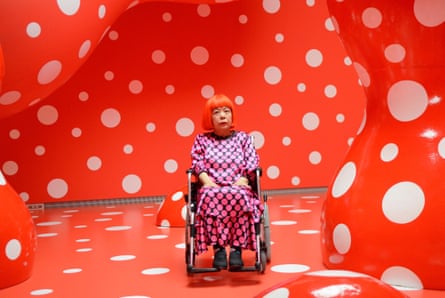
Yayoi Kusama: why this 96-year-old artist’s show is the most popular in Australian history
By the time the NGV exhibition of works by the Japanese favourite ends, more than half a million people will have seen it
Sian Cain
Monday 14 April 2025
The National Gallery of Victoria’s Yayoi Kusama has become the best attended ticketed art exhibition in Australian history, with “easily more than half a million people” visiting the 96-year-old Japanese artist’s show in four months.
On Monday the Victorian premier, Jacinta Allan, announced the milestone by saying that the NGV’s exhibition had “brought five MCGs worth of visitors to the heart of Melbourne” – or more than 480,000 people since it opened in December; about 40% were from interstate or overseas. This smashes a record the NGV set in 2017 with its exhibition Van Gogh and the Seasons – which was visited by 462,262 people.
But the curator of Yayoi Kusama, Wayne Crothers, the NGV’s senior curator of Asian art, tells the Guardian that that figure will “easily” surpass 500,000 by the time it ends on 21 April; in the show’s final days, the NGV is extending its opening hours to midnight so any stragglers – or repeat fans – can see it before it shuts.
“We were thinking, will it get to 500,000, maybe just? But we know now it will well surpass that,” Crothers says.
Why has Yayoi Kusama been such a huge success – even amid a cost-of-living crisis, when people are pickier than ever about what art they’ll pay for? Kusama is among the world’s most famous living artists, and is indisputably the world’s top-selling female artist – so part of it is down to her reputation. But undeniably some of the interest in the exhibition stems from the sheer visual appeal of Kusama’s colourful, often deceptively cheerful-looking work; ever since the NGV exhibition opened, children have been drawn to her giant “dancing pumpkin” in the gallery’s foyer (which will have a permanent home at the NGV once the show ends) and the multiple rooms filled with spotty, inflatable noodles.
“I have observed and overheard a lot of people say they are not usually gallery visitors, but they came because of the interest it was inspiring in people they knew,” Crothers says.
Even with her dark inspirations – oblivion, death, sex, war – the recurring symbols Kusama uses, such as flowers, polka dots and pumpkins, are irresistible to children, which means she can draw in families. Her incredibly selfie-friendly body of work also attracts young people who may bring their friends – and sometimes even return with their parents.
“Traditionally it has worked the other way – the older generations often bring in the young people who are less likely to regularly go to galleries. We’ve seen the opposite here,” says Crothers. “Then the people who found it emotional and special have come back for second visits. Some people thought, ‘Oh the grandkids will love this’, and came back with them. So there has been a snowballing effect, which has brought us an audience which is very different from our norm – that is a great thing.”

Kusama’s infinity room made for the NGV show, titled My Heart is Filled to the Brim with Sparkling Light. Photograph: Sean FennessyAnd then there are Kusama’s kaleidoscopic “infinity rooms”, mirror-lined spaces that use reflections of light to evoke a dizzying sense of the cosmic. These are perhaps what she is now most famous for, in the Instagram era; the NGV had to introduce a queueing system and a brisk 30 to 40 second time limit to manage the huge public appetite, with each room also having its own gallery attendant to explain the rules and move people along. There is a way to get longer inside a Kusama infinity room: one couple held their wedding at the NGV and had their photos taken inside one.
Some art critics have been a bit sniffy about Kusama’s mass appeal – the New York Times once wrote that her “sometimes blandly decorative installations” were “the art world’s equivalent of Star Wars premieres”. But what is the point of being a snob when she can bring in crowds bigger than this year’s Formula One Grand Prix? (That’s 405,000 tickets, if you’re wondering.)
“When the first impressionist show opened in 1870, art buffs were snobbish about it being commercial and for the common masses,” Crothers says. “But innovation is not really understood by the mainstream of the moment. People are critical of new things they don’t want to understand. The criticism of the pop artists in the 1970s – people said, ‘this isn’t art’. It’s repeated all through history, and probably denotes something as pushing the boundaries.”
“It’s a compliment!” he adds. “If people say, ‘I think it’s just crass populism’ – why shouldn’t art be enjoyed by the general masses?”

